Bit Fitting
A correctly fitted bit matters enormously. Get it wrong and your horse risks injury in the mouth, and the two of you will find it harder to communicate.
Before you start hunting for the right bit, have your horse's mouth examined by an equine dentist. This is usually done once a year, but may need doing more often if you suspect something is amiss, or if your horse has a known problem in the mouth. Vague signs such as changes in behaviour or problems in the way the horse moves can sometimes trace back to pain or discomfort in the mouth.
Finding the right length, height and design of bit for your particular horse matters, but it can feel tricky. The common mistakes are sitting the bit too high and using a bit that is too long, often both at once. The HayHay guide to bit fitting takes you through fitting a bit step by step.
Would you rather read about how specific bit designs work? Have a look at the guides to snaffle bits, curb bits and gag bits.
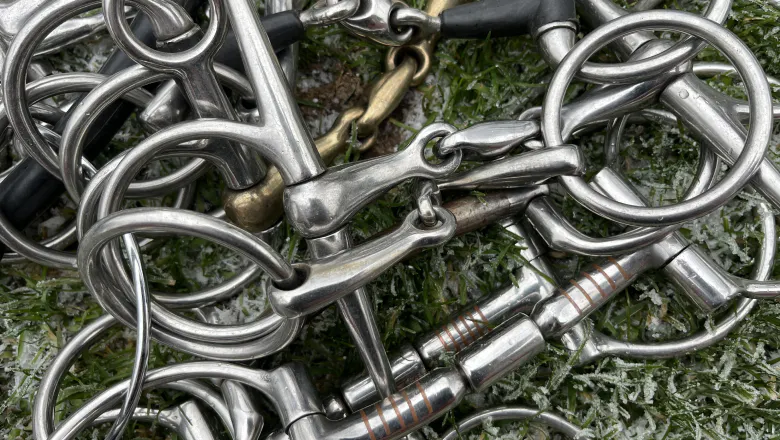
How to fit a bit:
How long should a bit be?
On a bit of the right size, the bit ring should rest against the corner of the mouth without pressing into it. The bit should sit no more than just under half a centimetre out between the corner of the mouth and the bit ring, otherwise it is too long. Nor should the bit be so short that the bit ring presses into the corner of the mouth.
With fixed rings you can often drop half a size or a full size compared with a bit on loose rings. Loose rings need the larger size because they risk pinching the corners of the mouth. Fitting bit guards reduces the risk of pinching, but because the guards take up room at the side of the mouth, the bit then needs to be a touch longer.
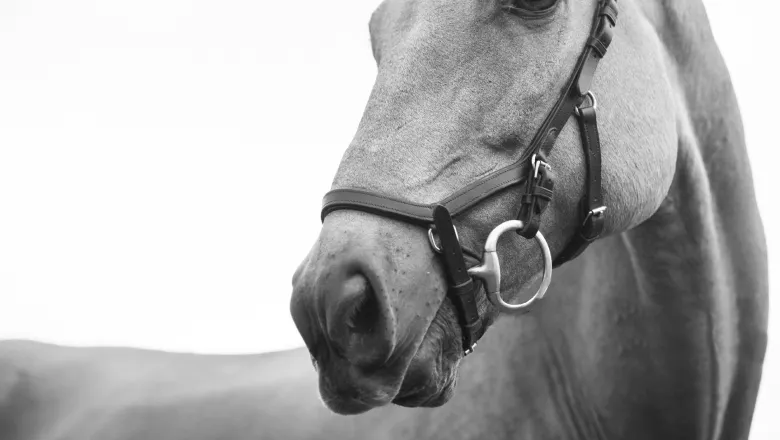
The image shows a bit that is too long. The mouthpiece protrudes from the corner of the mouth, and the bit will slide about in the mouth. On a jointed bit that is too long, the joint risks creating extra pressure against the bars or the palate, which is painful.
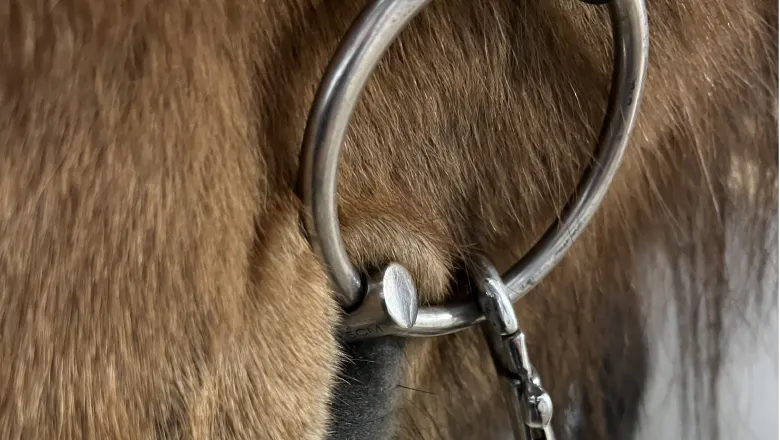
The image shows a bit that is too short. The bit ring presses into the corner of the mouth, which among other things raises the risk of pressure injury to the lining of the mouth and cheek.
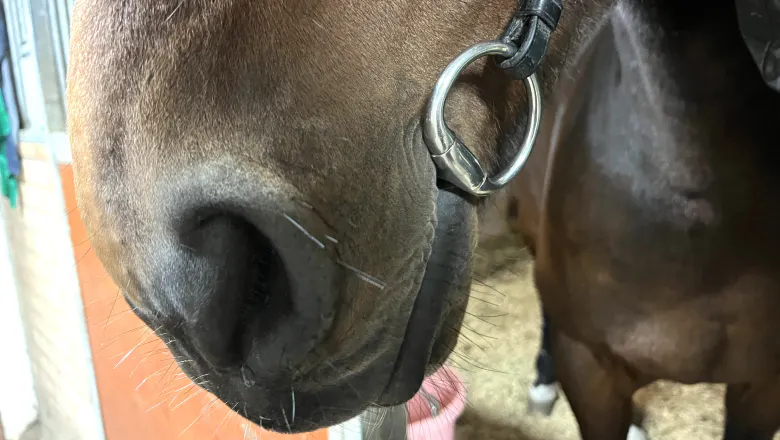
The image shows a bit in a good size. It sits firm and stable without pressing into the corners of the mouth.
How high should the bit sit?
A common myth is that there should be one or two wrinkles at the corners of the mouth, but that is not true. How much skin a horse has at the corners of the mouth varies from horse to horse. Wrinkles at the corner of the mouth are therefore no basis for setting the height of the bit.
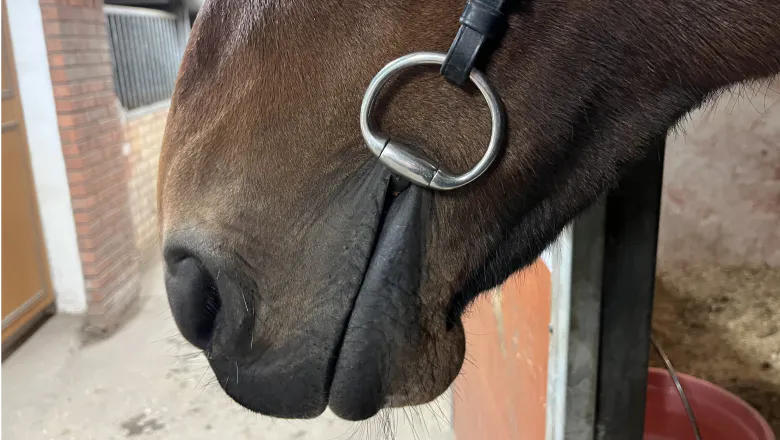
The image shows a bit sitting too high. It creates constant pressure in the mouth and a strain on the corners of the mouth. It also makes it harder for the horse to feel the release.
For the height, it is usually easiest to let the horse choose for itself. Lower the bit enough that it hangs loosely in the mouth. The horse will fiddle with the bit and then settle it at a height that feels comfortable. Adjust the cheekpiece to match. Part the corners of the mouth to check that the bit does not sit against a tooth. If the horse has canine teeth (the tushes), the bit can sometimes lie against them when they sit further back in the mouth and the bit is too low.
Once you have looked in the mouth, you can feel for the first cheek tooth. Press just above the corner of the mouth and you will feel something hard, the first cheek tooth. There should be around two fingers' width between the bit and the first cheek tooth so that the bit does not sit too high.
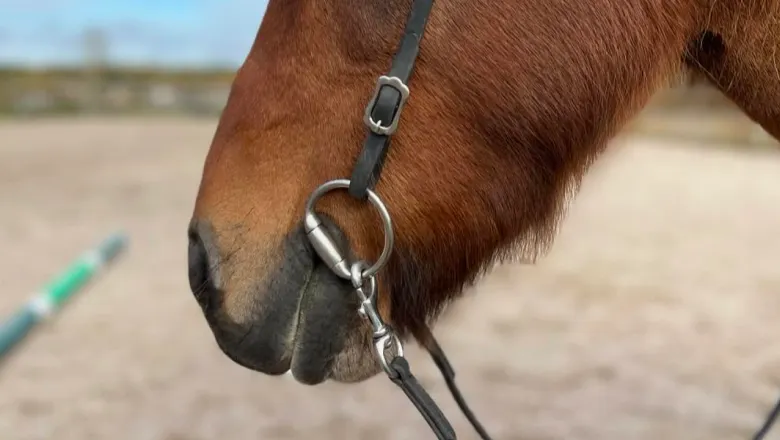
The image shows a bit sitting at a sensible height. It lies relaxed in the mouth without creating upward pressure, yet it does not hang loose either.
How often should you vary the options?
The key to avoiding injury in the mouth, alongside a properly fitted bit and a soft hand, is to vary the bitting so that the pressure points change. A good general rule is to keep at least three options to rotate between each week, for example two bits (ideally one unjointed and one jointed) and one bitless option, or one bit and two bitless options. You should not use the same bit all the time. Bear in mind that every bit, used carelessly, can act painfully and uncomfortably on the horse, even the mildest in their action. Always remember to keep a soft hand and ride with a light contact.
Injury in the mouth can happen quickly. Look in the mouth after every ride, parting the corners of the mouth to see the roof of the mouth, the tongue, the corners of the mouth and the bars. Look for bruising, rubbing, swelling or redness. If the horse suddenly starts to behave differently under saddle, for example stops taking a contact with the bit or begins to chew over several rides in a row, it is a good idea to check the mouth. Injury in the mouth is painful, and if you suspect something is wrong it is important to call out a vet who is specially trained in equine dentistry.
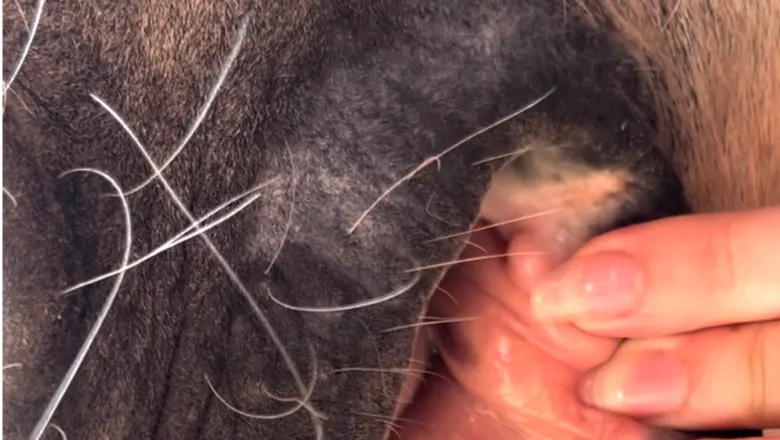
The image shows a bit-related injury at the corner of the mouth. The bit has cut into the lip, which here has begun to heal.
Every horse looks different inside the mouth and has a different amount of room for a bit. At your horse's annual dental examination, the equine dentist can help check that the tack suits your particular horse's anatomy.
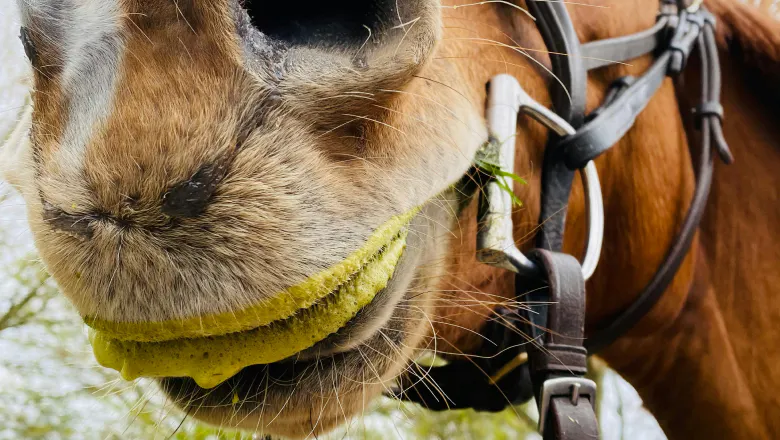
How do you know the horse is happy with the bit?
The horse's anatomy matters.
There is no single bit that suits every horse. Horses are individuals and, like us, have their own preferences and their own anatomy. Two horses of the same breed and size do not necessarily take the same bit size or have the same amount of room in the mouth. It also means that bits described as "anatomical" are not anatomical for every horse.
It is worth remembering that, anatomically, no horse really has room for a bit in its mouth. The bit makes room by pushing the tongue away from where it lies. Because of this, fitting the tack to the individual horse matters greatly if you want the best possible fit.
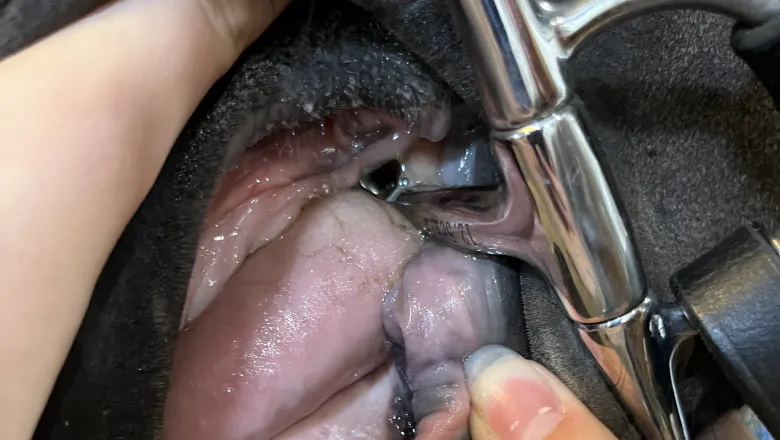
The image shows an example of how it can look inside the mouth when a bit lies there. This horse has a thicker tongue, so the effect of the bit on the tongue shows clearly.
Some horses have a slightly narrower tongue, a more arched or high palate, or less bulky cheeks. That gives a little more room in the mouth and a wider choice of bit designs. Others have a thick tongue, a low or less arched palate, and bulkier cheeks. That leaves less room to play with when it comes to bit fitting. Which type of bit is anatomically best for a horse depends on its individual make-up.
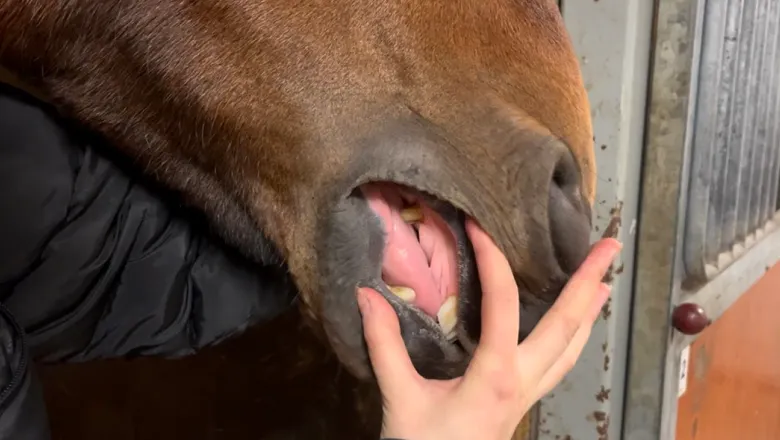
The image shows a horse's mouth from the side, with the tushes, part of the tongue and palate, and a few incisors visible.
How to tell whether the horse is happy with the bit.
A horse that is happy with the bit should be still and content in the mouth. It should not chew, gape or fiddle with its tongue, but should go relaxed, accept the contact and take a steady support. Because horses are herd animals and flight animals, they do not show pain or discomfort the way people do, so an untrained eye can find it hard to spot an unhappy horse.
The most common conflict behaviours linked to the mouth are chewing on the bit, gaping, and holding the tongue outside the mouth. These are ways for the horse to escape, or redistribute, the pressure in the mouth. An old myth holds that a horse chews on the bit when it is working correctly, but you should aim instead for a still mouth. Other conflict behaviours are throwing the head and tensing the muscles of the face.

The image shows a horse gaping to escape the pressure in the mouth. The tongue is drawn together, probably to spare it from the pressure. The expression in the horse's eye is tense too.
A horse that is easy to bridle, or that takes the bit willingly, is of course pleasant, but it is not necessarily a guarantee that it is happy with the bit. Study the horse's reaction and behaviour under saddle to form a picture.
Finally, remember that the bit is an important part of the tack, but a bit alone cannot solve problems rooted in the horse's rideability or in the communication between horse and rider. If you have a hot or keyed-up horse, for example, it matters more to work on the basics and on problem-solving, and to take help from a good coach, than to reach for a stronger bit as a long-term fix.