
How Gag Bits Work
Why does the right bit matter?
Choosing the right bit for your horse matters for both comfort and performance. A horse that is happy in its bit stays more relaxed, finds it easier to take a contact and works correctly. This guide helps you find your way through the maze of gag bits and shows you how each type acts.
The HayHay guide to gag bits is brand-neutral and covers the Dutch gag bit, the 3-ring bit, the 2.5-ring bit, the running gag, the curb gag bit, the Bevel bit (also called the 4-in-1 bit), the swivel bit and the Tom Thumb bit.
Read the HayHay guide to bit fitting too

Main bit categories
Bits fall into four families based on how they act: snaffle bits, curb bits, gag bits and combination bits. The bit has its own action, but the hand on the rein shapes it too. Remember that some bit actions, those of curb bits and gag bits, amplify the rider's rein aid. The pressure on the horse's face is therefore greater than the pressure the rider takes through the rein, even with a soft contact. Always ride with a soft hand and a light contact.
Gag bits
Gag bits come in two forms. The first looks much like a curb bit, but it carries no curb chain and the mouthpiece runs freely on the shank. Without a curb chain, the action turns extremely harsh. On this type of gag bit the moving rings lift the bit up in the mouth while the mouthpiece rotates. That can press hard on the horse's face, including the mouth and the poll. Beyond the pain it may cause, it sends conflicting signals: pressure at the poll tells the horse to lower its head, while pressure in the mouth tells it to raise its head. The Dutch gag bit and the 2.5-ring bit work this way.
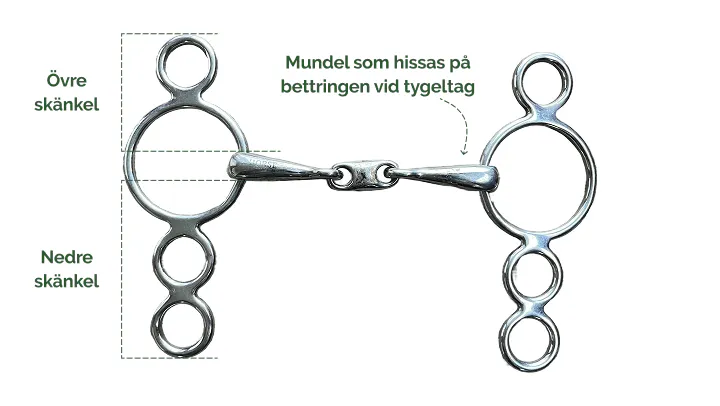
The image shows the parts of a gag bit with shanks, here using a Dutch gag bit as the example.
The second form of gag bit has no shank. Instead it runs on cords, the so-called gag straps, threaded through the bit ring and fastened in turn to the reins. On a rein aid the gag straps draw back towards the rider and the bit lifts up in the horse's mouth. This can become painful, because the lifting action presses on several sensitive areas and tissues in the horse's mouth. It also presses on the poll. This form has no stop either, which amplifies the rider's rein aid. The pressure on the horse's face is therefore greater than the pressure the rider takes through the rein, and this is a very harsh option. The running gag works this way.
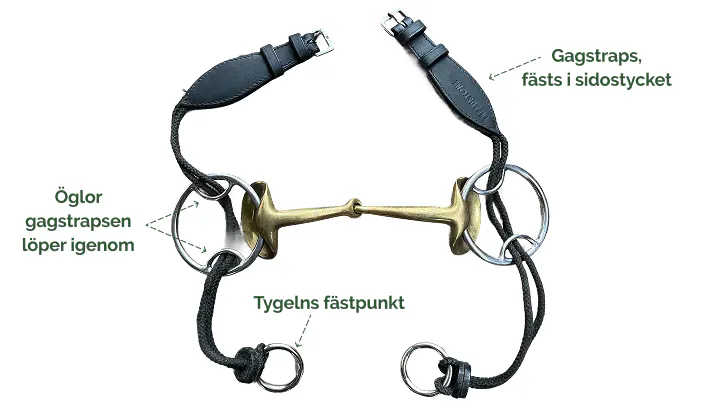
The image shows the parts of a gag bit without shanks, here using a running gag as the example.
Common gag bits and how they act
Dutch gag bit (also called the universal bit)
The Dutch gag bit has a shank made up of four rings. The cheekpiece attaches to the small ring at the top, then comes a large bit ring, and below it two more small rings. The rein usually attaches to one of the small rings. On a rein aid the shank draws back and up, rotating the mouthpiece. At the same time the bit lifts up in the mouth and pressure builds on the horse's poll.
The Dutch gag bit can become painful and uncomfortable for the horse. It takes only a light rein aid for the bit to act strongly, pressing on sensitive areas and tissues in the horse's face and mouth. This bit gives the horse conflicting signals. Pressure in the mouth tells the horse to raise its head, while pressure at the poll tells it to lower its head. Just how harsh the action becomes depends on which small ring you attach the rein to. The lowest small ring is the harshest. Attach the rein to the large bit ring instead and it acts like a Baucher bit, which makes it mild.
This bit should be used only by experienced riders and with great care. If you are using a Dutch gag bit, it is a good idea to switch to another option.
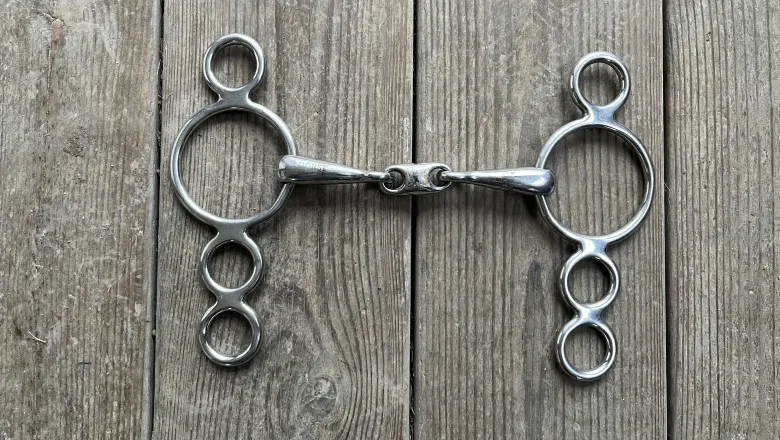
The image shows a three-piece Dutch gag bit.
3-ring bit and 2.5-ring bit (also called the universal bit)
The 3-ring bit and the 2.5-ring bit are two versions of the Dutch gag with fewer small rings below the large bit ring. They lift much like a Dutch gag with four rings, but the shank is a little shorter.
On a rein aid the shank draws back and up, rotating the mouthpiece. At the same time the bit lifts up in the mouth and can press hard on the poll. These bits are harsh and can cause the horse discomfort or pain even on light rein aids. They too give conflicting signals. Attach the rein to the large bit ring, though, and they act like a Baucher bit, which makes them mild. These bits should be used only by experienced riders and with great care, and if you are using them, it is a good idea to consider other options.
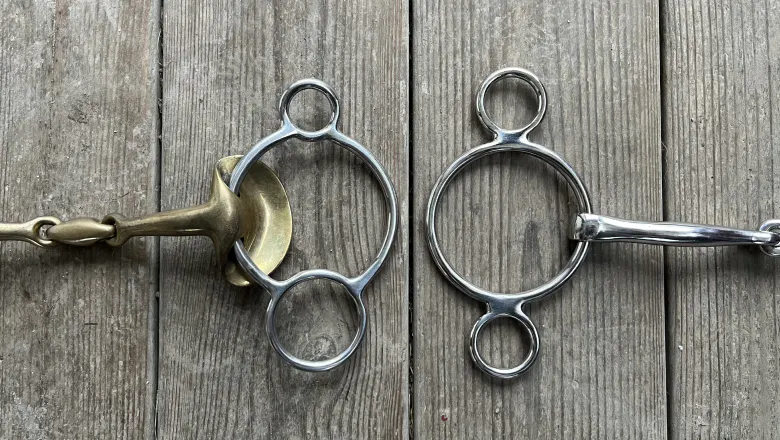
The image shows a 2.5-ring bit on the left and a 3-ring bit on the right.
Running gag
The running gag is a gag bit with no shank. Instead it runs on cords (gag straps) threaded through two loops in the bit ring. The loops can sit as holes in the bit ring itself, or as two holes inside the bit ring. The cords fasten to the reins.
On a rein aid the gag straps draw back towards the rider at an angle through the bit rings, and the bit lifts up in the mouth. It can become uncomfortable and painful, putting pressure on sensitive tissues, and the corners of the mouth take the most strain. The running gag also presses on the poll. Its effect is strong, because the angle between rein and gag straps is built to lift the bit up in the mouth more easily. It takes relatively little rein pressure for the bit to start lifting.
The running gag is commonly used on hot horses that become long and heavy in front, since pressure in the mouth lifts the head. Horses that are heavy in front or lean on the bit, though, often lack strength or feel discomfort. A bit that blocks the behaviour can mask or worsen the horse's problem rather than solve it. The running gag should be used with double reins, one pair fastened to the gag straps and one pair to the ordinary bit ring. The running gag is a harsh option, to be used only by experienced riders and with care.
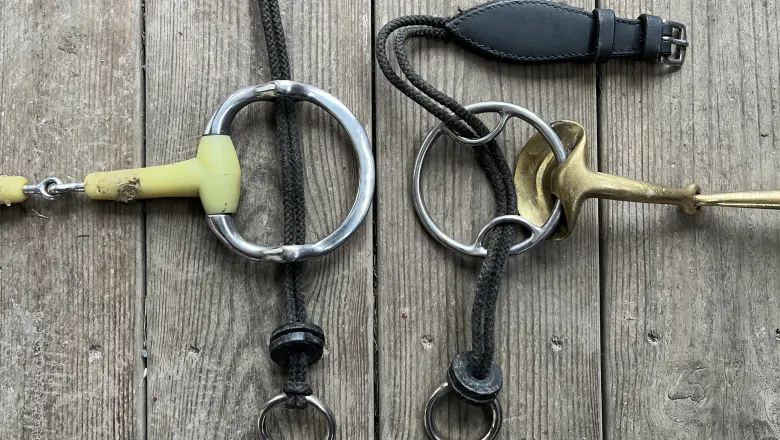
The image shows two forms of running gag, along with the gag straps threaded through the bit rings.
Curb gag bit
The curb gag bit is a gag bit similar to the running gag, but the curb gag puts pressure under the jaw instead of on the poll. The curb gag has a strap running through the two loops in the bit ring, on under the chin and then through the loops on the other bit ring. When you take up the reins, the mouthpiece is pushed up while the strap under the chin tightens. This can press hard in the mouth and under the jaw.
Some models of curb gag bit have an extra small ring fixed to the large bit ring. The cheekpieces attach to that small ring.
The curb gag is most commonly used on hot horses that become long and heavy in front, since pressure in the mouth lifts the horse's head. The bit should be used with double reins, one pair fastened to the strap running under the chin and one pair to the ordinary bit ring. The curb gag bit is a harsh option, to be used only by experienced riders and with care.
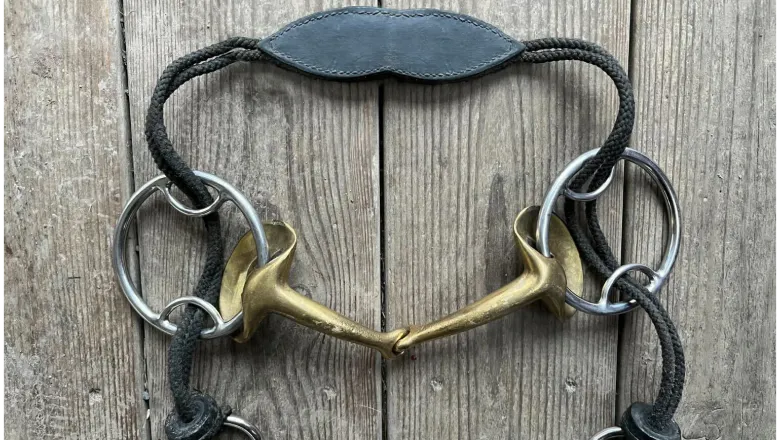
The image shows an example of how a curb gag can look, with the leather plate on the gag strap sitting under the horse's chin.
Bevel bit (also called the 4-in-1 bit)
The Bevel bit is a gag bit with two loops in the large bit ring. The cheekpiece attaches to one loop, the reins to the other. On a rein aid the bit ring rotates and the mouthpiece lifts, since it runs on the loose bit ring. This creates pressure inside the mouth. At the same time, pressure builds on the poll as the cheekpiece is pushed forward and down. This is a harsh bit, to be used by experienced riders.
The bit's effect can become uncomfortable or painful, because it presses on sensitive areas in the horse's mouth and face. You could describe the bit as a "baby Dutch gag", since it is a milder version of bits such as the 3-ring and 2.5-ring. It is still a harsh option, though.
The Bevel bit does have more uses, though. Thanks to the loops, there are several ways to attach the reins. Attach the cheekpiece to one loop and the reins to the large bit ring, for example, and you get a mild effect with added stability. You can also thread gag straps through the loops to make a running gag, which has a very harsh lifting action and must be used with great care.
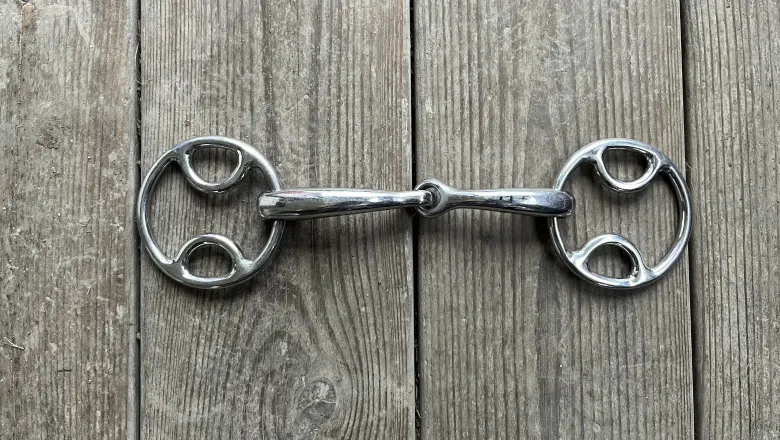
The image shows a two-piece Bevel bit.
Swivel bit
The swivel bit has the same build as the Bevel bit or the Dutch gag bit, but on each version a metal pin runs through the large bit ring. The mouthpiece is fixed there. The pin is there to make it easier for the bit to lift up in the mouth on a rein aid. On a rein aid the bit ring or shank rotates. At the same time the bit lifts up in the mouth by running on the metal pin, which can press hard on the poll as the cheekpiece is pushed forward and down.
These are harsh bits that can become uncomfortable or painful, because they press on sensitive areas in the horse's face. Keeping a soft hand is important. The Bevel version is a little milder than the Dutch gag version, but both still have a very harsh action. These bits should be used only by experienced riders and with great care. If you are using them, it is a good idea to switch to another option.
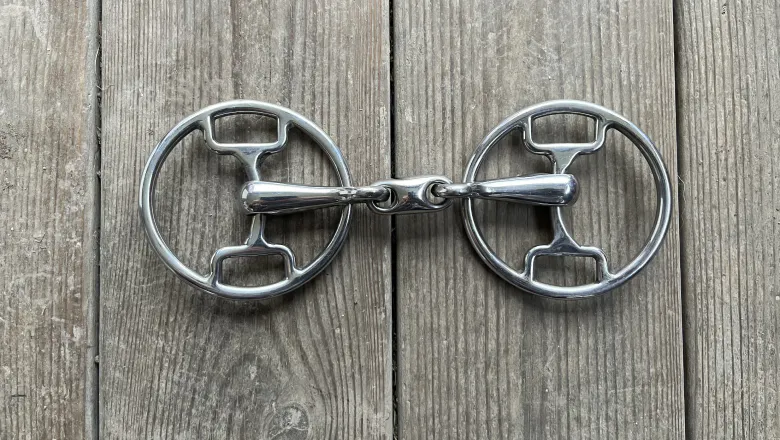
The image shows a three-piece swivel bit with Bevel side pieces.
Tom Thumb bit (also called the sweet-iron pelham)
The Tom Thumb bit is a very harsh gag bit similar in build to the Dutch gag bit. It has a shank with three rings fixed at intervals along a metal pin. The mouthpiece attaches to the middle ring, where it can run freely. The bit is usually three-piece and made of sweet iron, with a number of copper rings on the central link. The mouthpiece is often ridged.
On a rein aid the shank draws back and up, rotating the mouthpiece. At the same time the bit lifts up in the mouth and can press hard on the poll. The Tom Thumb bit can become uncomfortable and painful, because it presses on sensitive areas in the horse's face. It takes only a light rein aid for the bit to act strongly. This bit gives the horse conflicting signals. Pressure in the mouth tells the horse to raise its head, while pressure at the poll tells it to lower its head.
The copper rings on the central link are meant to keep a restless horse occupied. There is a risk, though, that they pinch inside the mouth, press on the palate or put point pressure on the tongue. Some riders use a curb chain on the Tom Thumb bit, which produces a combination of curb and gag action. The bit still lifts up in the mouth by running on the loose bit ring, but how far the shank can draw back is limited. It is still a harsh option with a curb chain.
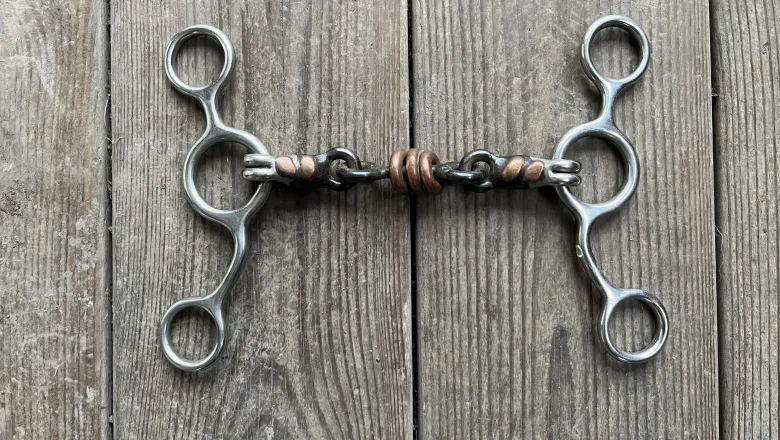
The image shows a Tom Thumb bit.


