
How Curb Bits Work
Why does the right bit matter?
Choosing the right bit for your horse matters for both comfort and performance. A horse that is happy in its bit relaxes more readily, takes a contact more easily and works correctly. This guide helps you find your way through the maze of curb bits and explains how each type acts on the horse.
The HayHay guide to curb bits is brand-independent and covers the kimblewick, the kimblehook (Flippan bit), the Baby Pelham, the Pelham, the double bridle, the Icelandic curb bit and the Scourier bit.
Read the HayHay guide to bit fitting too.

The main categories of bit
Bits fall into four families based on how they act: snaffle bits, curb bits, gag bits and combination bits. The bit has its own action, but the hand on the rein shapes that action too. Remember that some of these actions, those of curb bits and gag bits, amplify the rider's rein aid. This means the pressure on the horse's face is greater than the pressure the rider takes on the rein, even with a soft contact. Always ride with a soft hand and a light contact.
Curb bits
A curb bit has shanks and a curb chain, and it acts through leverage. The reins attach to the small ring at the bottom of the shank and the cheekpieces to the small ring at the top, which makes the bit rotate. A curb bit changes the direction of the force on the rein and amplifies the rein aid through that lever arm. Because the angle changes, the bit applies pressure at the poll while the curb chain tightens under the chin. As the mouthpiece rotates, it presses on the tongue and the bars. Depending on the model, there may also be pressure on the palate.
The curb chain should sit tight enough that the shank cannot rotate more than about 45 degrees. On a rein aid, the curb chain tightens under the jaw and stops the shank turning any further, which would otherwise increase the pressure. A common misconception is that a loose curb chain makes for a milder bit, but the opposite is true. One thing that decides how harsh the action becomes is the length of the shank: the longer it is, the harsher the bit.
A lip strap can also be used with a curb bit. It runs through the small rings on the shanks and through the large ring on the curb chain. The lip strap holds the bit steady, stopping the lower shank from twisting forward and the mouthpiece from sitting at the wrong angle.
Use curb bits with caution, and only if you are an experienced rider. Used well and softly, a curb bit is meant to give refined aids, precision and the option of asking with less pressure on the rein. If you do choose a curb bit, pick a straight model. A jointed mouthpiece loses the action the design is really meant to deliver, and a jointed curb bit becomes a particularly harsh bit that can also press hard against the palate and the bars.
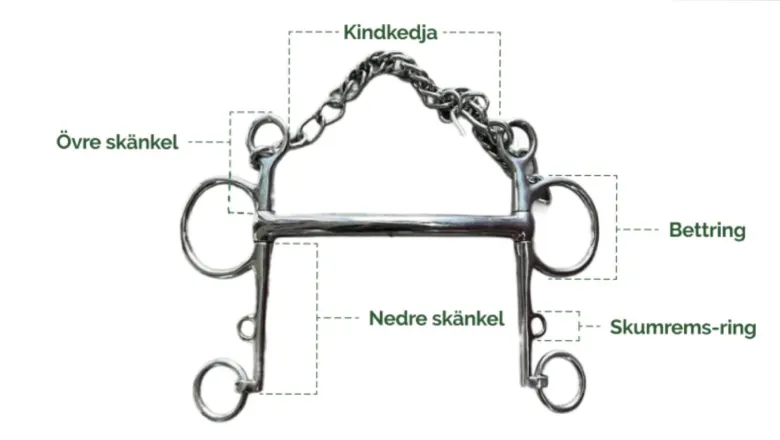
The image shows the parts of a curb bit.
Common curb bits and how they work
Kimblewick
The kimblewick is a curb bit with a D-shaped shank. A typical kimblewick gives three ways to attach the rein: two holes set at different heights within the D-ring, and the usual position on the bit ring itself. The action changes depending on which you use.
The lower hole on the bit ring gives the harshest option, because the leverage is greatest there. On a rein aid, the bit rotates in the mouth, the shank is drawn back towards the rider and pressure builds at the poll, in the mouth and under the jaw. The upper hole works the same way, but with less leverage, so the action is milder.
The large bit ring gives the mildest action, and the kimblewick then works much like a Baucher bit. The kimblewick is slightly milder than a Baby Pelham, is used with a curb chain, and works with either a delta strap or double reins. It often has a port. Where a port is used, it is important to have a vet fit it, because the port asks for enough room in the mouth that the horse does not feel discomfort or pain.
Used for:
- several rein positions, which gives you options
- moving down from a harsher bit, since the different positions let you do it in small steps
- preferring over a Baby Pelham or Pelham when moving from mild to harsh
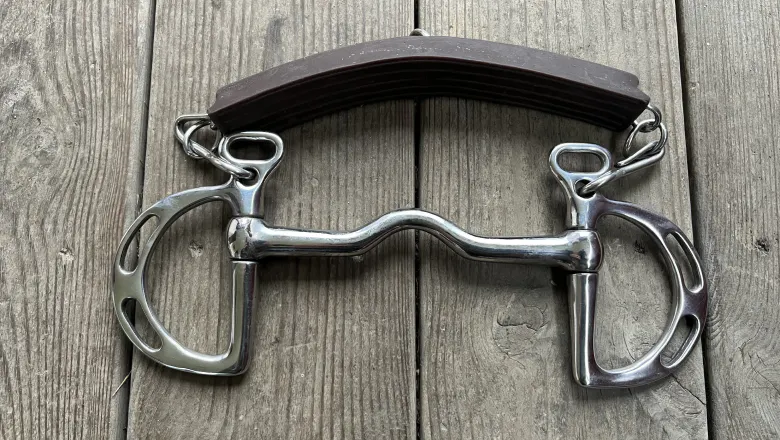
The image shows a straight kimblewick with a port. A curb-chain guard sits on the curb chain to soften it.
Kimblehook (Flippan bit)
The kimblehook acts much like a kimblewick, except that it has hooks on the bit ring instead of holes. It is a curb bit whose action changes with the rein position, and it is used with a curb chain.
Action:
- Set the rein under the lowest hook and you get a harsher lever that loads the poll, under the jaw and the mouth. This is roughly equivalent to a Baby Pelham.
- Attach the reins under the upper hook and you get a middle option. The bit still acts through leverage, loading the poll, under the jaw and the mouth, but less harshly than at the lower hook.
- Set the rein above the upper hook instead, and the kimblehook works like a mild Baucher bit.
This bit works well for moving down from a harsher bit, since you can do it in small steps. It can be used with double reins. The kimblehook sometimes has a port. Where a port is used, it is important to have a vet fit it, because the port asks for enough room in the mouth that the horse does not feel discomfort or pain.
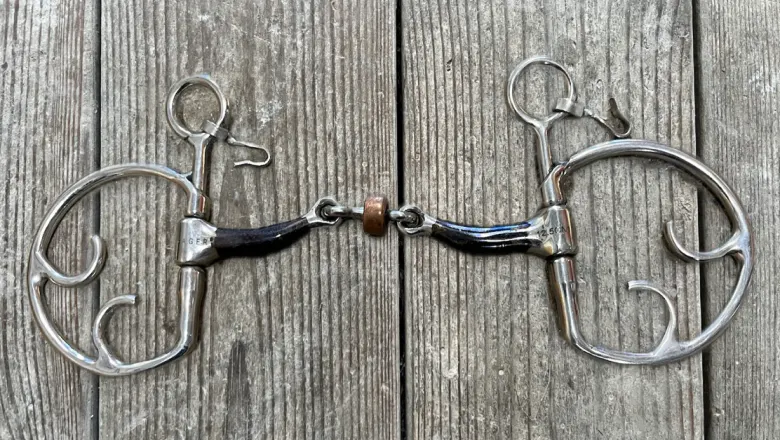
The image shows a double-jointed kimblehook (without a curb chain) with a port and a loose roller on the central link.
Baby Pelham
The Baby Pelham is a harsh curb bit with a shorter shank than a Pelham, which is where the name comes from. On a rein aid, the shank is drawn back towards the rider and the cheekpiece is pushed forward and down. This loads the tongue, the bars, the poll and under the jaw. It can become uncomfortable or painful, especially if used carelessly, because the leverage loads sensitive areas of the mouth and face. The leverage also gives the bit more effect than the hand puts into the rein.
The Baby Pelham is a milder version of an ordinary Pelham. It is used mostly for jumping, cross-country and hacking, mainly on keener, hotter horses. Reserve it for experienced riders and use it with caution. Ideally use it with a delta strap or double reins, for a slightly more controlled effect. The Baby Pelham sometimes has a port. Where a port is used, it is important to have a vet fit it, because the port asks for enough room in the mouth that the horse does not feel discomfort or pain.
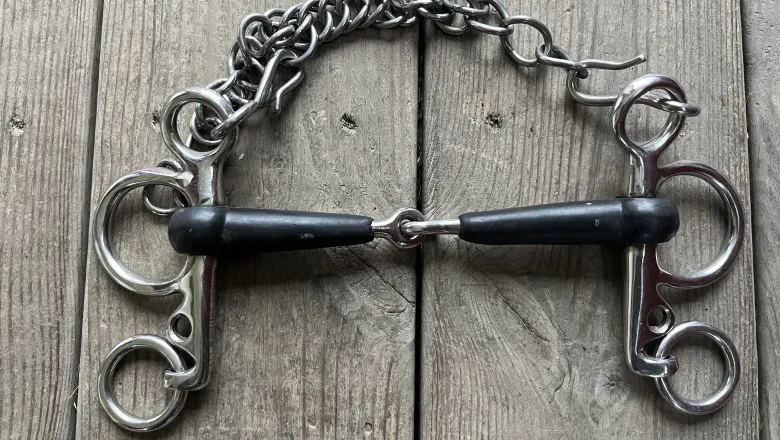
The image shows a single-jointed rubber Baby Pelham.
Pelham
The Pelham is a harsh curb bit, most common in jumping, cross-country and working equitation. On a rein aid, the shank is drawn back towards the rider and the cheekpiece is pushed forward and down. This loads the tongue, the bars, the poll and under the jaw. It can become uncomfortable or painful, because the leverage loads sensitive areas of the mouth. Through that leverage, the bit applies more pressure than the hand puts into the rein.
Some describe the Pelham as a double bridle in one piece, with the large ring acting as the snaffle and the lower small ring as the curb. That is why riders often use two reins with a Pelham, so they can give refined aids. As long as you take a contact on the large bit ring, the bit stays mild. If you do not use double reins, a delta strap is strongly preferable. The Pelham sometimes has a port. Where a port is used, it is important to have a vet fit it, because the port asks for enough room in the mouth that the horse does not feel discomfort or pain. Reserve the Pelham for experienced riders and use it with caution.
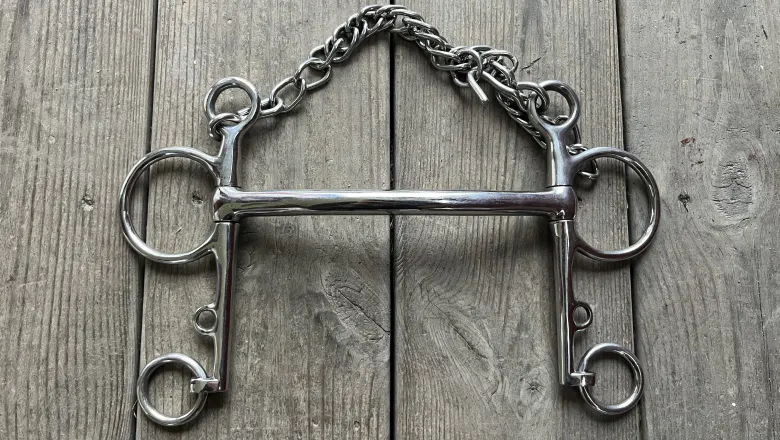
The image shows a straight, mullen-mouth Pelham.
Double bridle
A double bridle uses two bits in the horse's mouth: the bridoon and the weymouth. The bridoon is a narrower version of a jointed snaffle, with smaller bit rings. The weymouth is a curb bit. It often has a port, though not always. The port asks for enough room in the mouth that the horse does not feel discomfort or pain. The shank length varies too, and the longer it is, the harsher the bit. The weymouth is used with a curb chain and can also be combined with a lip strap. It sits below the bridoon.
Anatomically, a horse does not really have room for one bit in its mouth, and a double bridle puts two in there. It takes up a great deal of room and applies pressure simply by lying in the mouth. The tongue is especially exposed, so fitting the double bridle correctly is vital. Get help from an equine dentist. Not every horse can take a double bridle, as some have too small a mouth or other features that make it unsuitable. The bridoon should be the same size as the horse's ordinary snaffle, and the weymouth half a centimetre to a centimetre longer so that it can move outside the bridoon.
On a rein aid, the double bridle applies considerable pressure in the mouth and on other parts of the head, such as the poll. It is used at the higher levels of dressage. Ridden with double reins, it is meant to give greater precision in the difficult movements. It is a very harsh bit and, where used, must be used with great care by experienced riders. Used carelessly, it becomes very harsh and painful.
The weymouth and the bridoon can also be used separately:
- The weymouth: works like a Pelham.
- The bridoon: a narrower version of a single- or double-jointed snaffle that applies slightly more point pressure because of its narrower bearing surface, but can suit horses with a small mouth.
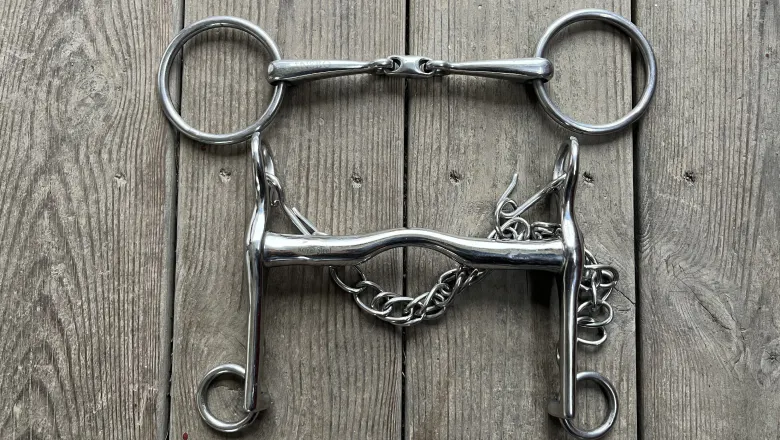
The image shows the two bits of a double bridle: a double-jointed bridoon and a mullen-mouth weymouth with a port.
Icelandic curb bit
The Icelandic curb bit is a single- or double-jointed curb bit used only on Icelandic horses. It is recognisable by its wide shanks with a small loose ring at the bottom, where the reins attach. The shanks come in both long and short versions, and the longer they are, the harsher the leverage. The Icelandic curb bit differs from other curb bits because the cheekpieces attach to the large bit ring. There is therefore less pressure at the poll. The bit is designed to lie flat towards the ground, almost like an extension of the rein.
The mouthpiece sits on a small metal pin inside the shank. On a rein aid, the mouthpiece lifts in the mouth, sliding up the pin until it reaches the stop. The Icelandic curb bit therefore has a form of gag action too. Because the bit is built for a large rotation, the lift is meant to avoid the dead, locked feel of a fixed mouthpiece, which on an ordinary curb bit produces a hard, stiff rotation.
Once the lift reaches the end of the pin, the mouthpiece locks and draws the large bit ring forward and down. The design gives a little pressure at the poll. The tongue and the bars are especially exposed because of the rotation of the mouthpiece. By pressing on sensitive areas of the face and mouth, the bit is designed to place the Icelandic horse's head and neck in a position that scores well for tölt and pace. The Icelandic curb bit sometimes has a port. Where a port is used, it is important to have a vet fit it, because the port asks for enough room in the mouth that the horse does not feel discomfort or pain.
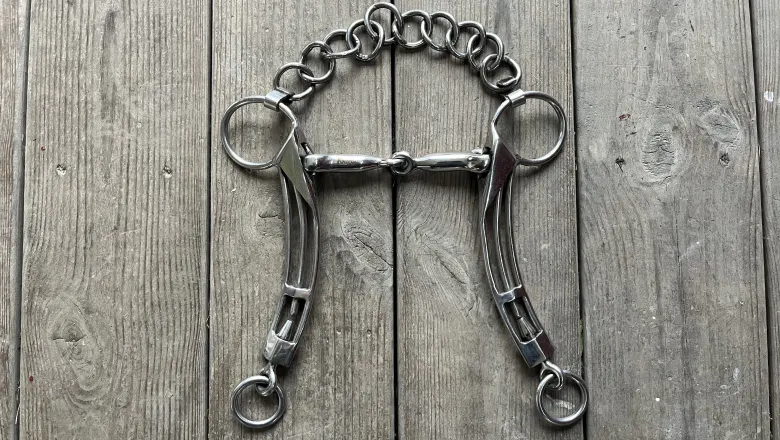
The image shows a single-jointed Icelandic curb bit.
Scourier bit
The Scourier bit is a single-jointed bit with four bit rings, a pair on each side. The cheekpieces attach to the inner rings on the upper side. The reins attach to the outer rings on the lower side. In the mouth, the rings look like a figure of eight from the side. The mouthpiece is either smooth or ridged, and it is more square than round. The edges give the bit a sharper feel and therefore a harsher action.
The inner upper rings act more as a fixed point and barely move. On a rein aid, the outer lower rings turn until they catch on the fixing point in the mouthpiece. They catch because they take a different angle from the upper ring. The two rings lock together. This produces a leverage action with rotation in the mouth. If the mouthpiece is ridged, it grinds against the tongue and the bars.
Once the rings reach the locked position, the lower rings are drawn back and up. This folds the jointed bit in the mouth and risks it striking up into the palate. The rings holding the cheekpieces are pressed together against the horse's cheeks, and the harder you take a contact, the more the bit folds and the harder the horse's face is squeezed together.
Because of the squared mouthpiece, the way the face is squeezed and the hard pressure on so many sensitive areas, the Scourier bit is a very harsh option. Reserve it for experienced riders and use it with caution. If you are using a Scourier bit, it may be a good idea to look for another option. Straight Scourier bits also exist, with a slightly milder effect.
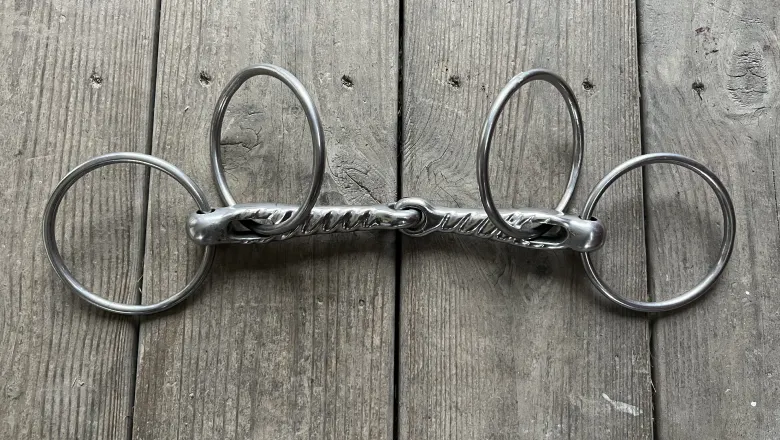
The image shows a Scourier bit with a ridged mouthpiece.


